Becoming a Lifelong Learner (12-18 yr)
Becoming a Lifelong Learner
We now accept that learning is a lifelong process of keeping abreast of change. And the most pressing task is teaching young people how to learn.
-Peter Drucker
A Case for the Science of Learning
Educators flourish when their students succeed, but we setup both to fail if neither are ever exposed to the science of learning -rich body of evidence containing strategies to leverage for learning and teaching
Learning is a scientific process, and for students to learn optimally they must be taught (Dunlosky, 2021).
A truly effective learner needs “[to] engage in activities that foster storage of new information and subsequent access to that information..” (Bjork et al., 2013).
Students use ineffective techniques such as highlighting and re-reading, with limited success. Such strategies are rooted in the misconception about learning (Bjork & Bjork, 2011).
Misconceptions about teaching and learning based on intuition have led to an epidemic of disengagement in schools (Evans, 2023).
of educators report that their students don’t know how to learn effectively.
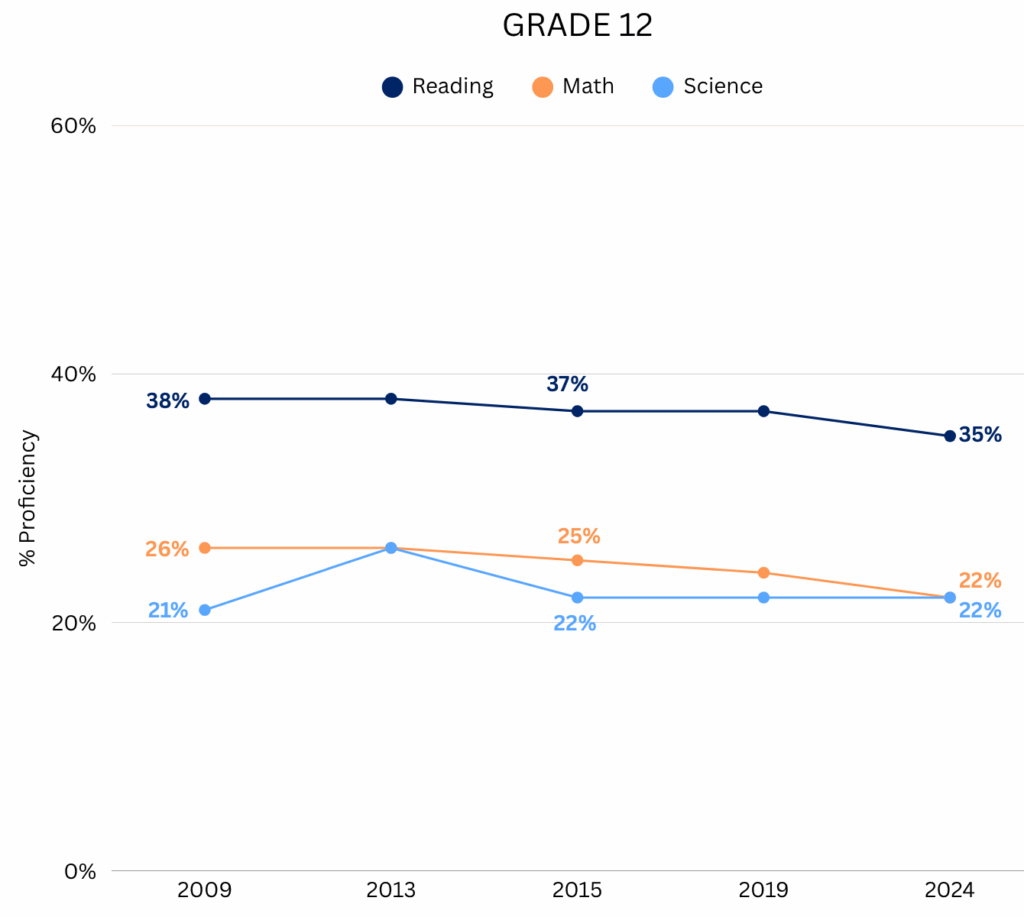
12th Grade Proficiency – According to NAEP
As of 2024, only 22% of 12th-grade students performed at or above the Proficient level in mathematics, 35% in reading, and about 22% in science.. These results reflect a steady decline or stagnation across subjects since 2009, with little improvement among higher performers and continued gaps for lower-performing students.
Skills for Learning
While 76% of countries identify specific skills, such as creativity, critical thinking, social and emotional skills, and problem solving, in their mission and vision statements, only 6% consistently identify skills and how to develop these for students. (Brookings Institute)
high school graduates are fully prepared for college. (Education Week, 2023)
Wellbeing
99% students who face academic challenges say they affect their mental health.
In 2023, CDC found that: 4 in 10 (40%) students had persistent feelings of sadness or hopelessness. 20% seriously consider suicide, and 10% attempt it. Most students reporting negative feelings also struggle academically.
Absenteeism & Student Engagment
Chronic absenteeism remains 75% above the pre-pandemic baseline.
75% of third graders are engaged, but by tenth grade, only 25% remain engaged.
A Global Crisis:
By 2030, there will be a global human talent shortage of over
This equals to
loss to global GDP (Korn Ferry, 2023)
A global crisis is emerging of learners of all ages being unprepared for future employment and prosperity (UNICEF, 2022), increasing achievement and opportunity gaps (UNESCO, 2023) with “uneducated, uninspired, and unskilled” learners (UNICEF, 2022).
Empowering Students to Take the Driver’s Seat
When students understand how learning works, they unlock more than academic success, they gain ownership of their growth. COGx equips learners with the science-based tools to learn deeply, think critically, and apply knowledge with purpose.
By mastering how to learn, students move beyond memorization to meaningful understanding, closing the skills gap from within. They build the confidence and cognitive agility needed to navigate complex challenges, collaborate effectively, and thrive in the 21st-century world.
This is how readiness begins – not with test preparation, but with empowered learners who can adapt, create, and lead their own learning journeys.
Available for 3 levels
Middle School
High School
College
Delivered in 3 languages
English
Spanish
Arabic
COGx Program for Students (Middle School–College)
In this program, students learn how to learn—developing the cognitive skills and strategies that turn effort into lasting understanding. Grounded in the Science of Learning, it builds independent, lifelong learners ready to adapt and thrive. Versions are available for different ages and learning needs.
Tailored to Every Classroom
Flexible by design, COGx programs empower educators to bring the Science of Learning to life. Schools customize implementation to fit their priorities and schedules, ensuring each experience is relevant, practical, and impactful.
What Students Learn:
- Study Habits
- Executive Function
- Metacognition
- Encoding Techniques
- Retrieval Strategies
- Neuroplasticity
- Learning Myths
- Attention
- Engagement
- Critical Thinking
- Self Regulation
COGx Impact
Countries
COGx is proud to have collaborated with over 20 countries adopting to local language and culture.
Self-Efficacy
Within two months of engaging in the COGx Student program, surveys revealed a 24% increase in students’ confidence in themselves as learners.
Metacognition
COGx Improves Metacognition by 1.6 Standard Deviations, which is better than 1 year of schooling!